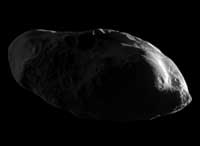
Saturn XVI - 1980S27
Prometheus [pra-MEE-thee-us] is the third of Saturn's known satellites. It was discovered from photographs taken by Voyager during its encounter with Saturn by S. Collins and others. Prometheus acts as a shepherd satellite for the inner edge of Saturn's F Ring. The moon is extremely elongated about 145 by 85 by 62 kilometers (90 by 53 by 39 miles) in diameter. It has a number of ridges and valleys on its northern side. Several craters about 20 kilometers (12 miles) in diameter are visible, but it appears to be less cratered than its nearby neighbors Pandora, Janus and Epimetheus. The density of Prometheus has been estimated to be quite low, indicating that is a porous, icy body; however, there is a lot of uncertainty in these values.
| Prometheus Statistics | |
|---|---|
| Discovered by | S. Collins & others |
| Date of discovery | 1980 |
| Mass (kg) | 2.7e+17* |
| Mass (Earth = 1) | 4.5181e-08 |
| Radius (km) | 72.5x42.5x32.5 |
| Radius (Earth = 1) | 1.1367e-02 |
| Mean density (gm/cm^3) | 0.7* |
| Mean distance from Saturn (km) | 139,350 |
| Rotational period (days) | ? |
| Orbital period (days) | 0.6130 |
| Mean orbital velocity (km/sec) | 16.54 |
| Orbital eccentricity | 0.003 |
| Orbital inclination (degrees) | 0.0 |
| Escape velocity (km/sec) | 0.0223 |
| Visual geometric albedo | 0.6 |
| Magnitude (Vo) | 15.8 |
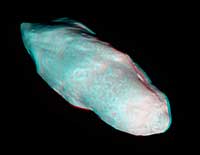
Saturn's potato-shaped moon Prometheus is rendered in three dimensions in this close-up from Cassini.
This 3-D view is a color composite picture made from two different black and white images that were taken from slightly different viewing angles. The images are combined so that the viewer's left and right eye, respectively and separately, see a left and right image of the black and white stereo pair when viewed through red-blue glasses.
This view looks toward the leading hemisphere of Prometheus (86 kilometers, or 53 miles across). North on Prometheus is up and rotated 47 degrees to the right. The end of Prometheus on the lower right points toward Saturn, and the end on the upper left points away from the planet.
The images were taken in visible light with the Cassini spacecraft narrow-angle camera on Dec. 26, 2009. The view was obtained at a distance of approximately 57,000 kilometers (35,000 miles) from Prometheus and at a Sun-Prometheus-spacecraft, or phase, angle of 33 degrees. Image scale is 339 meters (1,112 feet) per pixel.
(Courtesy NASA/JPL/Space Science Institute)
Cratered Spud
Appearing like eyes on a potato, craters cover the dimly lit surface of the moon Prometheus in this high-resolution image from the Cassini spacecraft's early 2010 flyby.
The Jan. 27 encounter represented the closest imaging sequence yet of that moon for Cassini. This view looks toward the trailing hemisphere of Prometheus (86 kilometers, or 53 miles across). North on Prometheus is up and rotated 8 degrees to the right.
The moon is lit by sunlight on the right and Saturnshine on the left.
The image was taken in visible light with the Cassini spacecraft narrow-angle camera on Jan. 27, 2010. The view was obtained at a distance of approximately 34,000 kilometers (21,000 miles) from Prometheus and at a Sun-Prometheus-spacecraft, or phase, angle of 126 degrees. Image scale is 200 meters (656 feet) per pixel.
(Courtesy NASA/JPL/Space Science Institute)
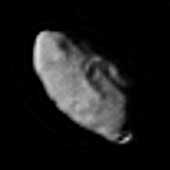 Prometheus
This image of Prometheus was acquired by the Voyager 2 spacecraft on
August 25, 1981.
(Copyright Calvin J. Hamilton)
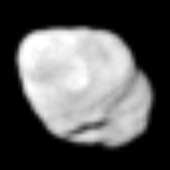 Lumpy Prometheus
Saturn's shepherd moon Prometheus reveals its elongated, irregular form to
Cassini in this image. The moon's long axis points toward Saturn.
Prometheus is 102 kilometers (63 miles) across.
This view shows the southern part of the moon's anti-Saturn side (the face that always points away from Saturn).
The image was taken in visible red light with the Cassini spacecraft
narrow-angle camera on June 7, 2005, at a distance of approximately
438,000 kilometers (272,000 miles) from Prometheus. Resolution in the
original image was 3 kilometers (2 miles) per pixel. The image has been
contrast-enhanced and magnified by a factor of two to aid visibility.
(Courtesy NASA/JPL/Space Science Institute)
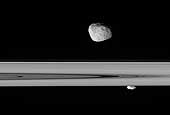 So Close
Saturn's moons Janus and Prometheus look close enough to touch in this
stunningly detailed view.
From just beneath the ringplane, Cassini stares at Janus (181 kilometers, or 113 miles across - on top) on the near side of the rings and Prometheus (102 kilometers, or 63 miles across - on bottom) on the far side. The image shows that Prometheus is more elongated than Janus.
The view takes in the Cassini Division (4,800 kilometers, or 2,980 miles
wide), from its outer edge to about halfway across its width.
(Courtesy NASA/JPL/Space Science Institute)
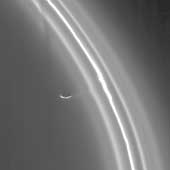 Thieving Moon
As it completed its first orbit of Saturn, Cassini zoomed in on the rings
to catch this wondrous view of the shepherd moon Prometheus (102
kilometers, or 63 miles across) working its influence on the
multi-stranded and kinked F ring.
The F ring resolves into five separate strands in this closeup view. Potato-shaped Prometheus is seen here, connected to the ringlets by a faint strand of material. Imaging scientists are not sure exactly how Prometheus is interacting with the F ring here, but they have speculated that the moon might be gravitationally pulling material away from the ring. The ringlets are disturbed in several other places. In some, discontinuities or "kinks" in the ringlets are seen; in others, gaps in the diffuse inner strands are seen. All these features appear to be due to the influence of Prometheus.
The image was taken in visible light with the narrow angle camera on Oct.
29, 2004, at a distance of about 782,000 kilometers (486,000 miles) from
Prometheus and at a Sun-Prometheus-spacecraft, or phase, angle of 147
degrees. The image scale is 4.7 kilometers (2.9 miles) per pixel. The
image has been magnified by a factor of two, and contrast was enhanced,
to aid visibility.
(Courtesy NASA/JPL/Space Science Institute)
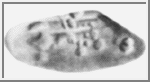 Shaded Relief Map of Prometheus
This image is a shaded relief map of Prometheus, the inner F Ring
Shepherd satellite of Saturn. As with all maps, it is the cartographer's
interpretation and not all features are necessarily certain given the
limited data available. This interpretation stretches the data as far
as is feasible. (Courtesy Phil Stooke)
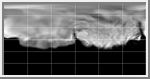 Simple Cylindrical Map of Prometheus
This map of Prometheus was created from Voyager 2 images of the satellite, and the shape model of Phil
Stooke. The map is centered at 0 degrees longitude.
(Courtesy A. Tayfun Oner)
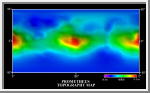 Topographic Map of Prometheus
This is a topographic map of Prometheus. It is based upon the shape model of Phil
Stooke. As with all maps, it is the cartographer's interpretation;
not all features are necessarily certain given the limited data
available. This interpretation stretches the data as far as possible.
(Courtesy A. Tayfun Oner)
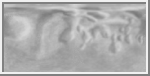 Cylindrical Map of Prometheus
This image is a shaded relief map of Prometheus, the inner F Ring
Shepherd satellite of Saturn. It is the same map as the above image, but
reprojected to the Simple Cylindrical projection. As with all maps, it
is the cartographer's interpretation and not all features are necessarily
certain given the limited data available. This interpretation stretches
the data as far as is feasible.
(Courtesy Phil Stooke)
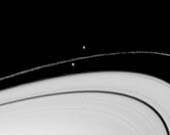 Prometheus and Pandora
This image shows Saturn's thin F-Ring with shepherd satellites
Prometheus and Pandora.
Prometheus is the inner moon and Pandora the outer.
This is a zoomed in section from the image
fring5.htm.
(Copyright Calvin J. Hamilton)
Stooke, P. J., "Shapes and Surface Features of Prometheus and Pandora," Earth, Moon and Planets, 62 (1993), 199-221.

 Saturn
 Atlas
Atlas Pandora