Saturn XII - 1980S6
Helene was discovered by P. Laques and J. Lecacheus on March 1, 1980 through ground based observations during the Earth ring-plane crossing. Helene is called a Dione Trojan satellite because it shares the same orbit as Dione at about 60 degrees ahead of its larger companion. Its diameter is about 36 x 32 x 30 kilometers (22 x 20 x 19 miles).
| Helene Statistics | |
|---|---|
| Discovered by | P. Laques & J. Lecacheus |
| Date of discovery | 1980 |
| Mass (kg) | ? |
| Radius (km) | 18x16x15 |
| Radius (Earth = 1) | 2.8222e-03 |
| Mean density (gm/cm^3) | ? |
| Mean distance from Saturn (km) | 377,400 |
| Rotational period (days) | ? |
| Orbital period (days) | 2.7369 |
| Mean orbital velocity (km/sec) | 10.03 |
| Orbital eccentricity | 0.005 |
| Orbital inclination (degrees) | 0.2 |
| Visual geometric albedo | 0.7 |
| Magnitude (Vo) | 18.5 |
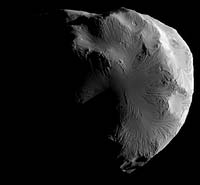
High-Res Helene
The Cassini spacecraft snapped this image of Saturn's moon Helene while completing the mission's second-closest encounter of the moon on June 18, 2011.
Although Cassini's closest flyby of Helene was in March 2010, this June 2011 flyby yielded some of the highest resolution images of the moon.
Lit terrain seen here is on the leading hemisphere of Helene (33 kilometers, or 21 miles across). North on Helene is up.
The image was taken in visible light with the Cassini spacecraft narrow-angle camera. The view was obtained at a distance of approximately 7,000 kilometers (4,000 miles) from Helene and at a Sun-Helene-spacecraft, or phase, angle of 104 degrees. Image scale is 42 meters (137 feet) per pixel.
(Courtesy NASA/JPL-Caltech/Space Science Institute)
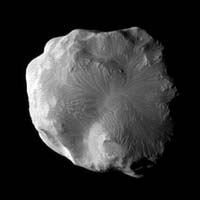 Flying by Helene
The Cassini spacecraft imaged the surface of Saturn's moon Helene as the spacecraft flew by the moon on Jan. 31, 2011.
This small moon leads Dione by 60 degrees in the moons' shared orbit. Helene is a "Trojan" moon of Dione, named for the Trojan asteroids that orbit 60 degrees ahead of and behind Jupiter as it circles the Sun.
This view looks toward the trailing hemisphere of Helene (33 kilometers, or 21 miles across). North on Helene is up and rotated 2 degrees to the left.
The image was taken with the Cassini spacecraft narrow-angle camera using a combination of spectral filters sensitive to wavelengths of polarized green light centered at 617 and 568 nanometers. The view was obtained at a distance of approximately 31,000 kilometers (19,000 miles) from Helene and at a Sun-Helene-spacecraft, or phase, angle of 65 degrees. Scale in the original image was 187 meters (613 feet) per pixel. The image was contrast enhanced and magnified by a factor of 1.5 to enhance the visibility of surface features.
(Courtesy NASA/JPL/Space Science Institute)
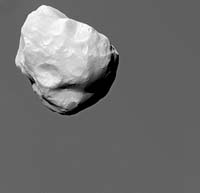 Catching Helene
Although travelling at great speed, the Cassini spacecraft managed to capture this close view of Saturn's small moon Helene during a flyby on March 3, 2010.
Saturn's atmosphere makes up the background of this composition.
This view looks toward the anti-Saturn side of Helene (33 kilometers, or 21 miles across). North on Helene is up and rotated 44 degrees to the right.
The image was taken in visible light with the Cassini spacecraft narrow-angle camera. The view was obtained at a distance of approximately 19,000 kilometers (12,000 miles) from Helene and at a sun-Helene-spacecraft, or phase, angle of 25 degrees. Image scale is 113 meters (371 feet) per pixel.
(Courtesy NASA/JPL/Space Science Institute)
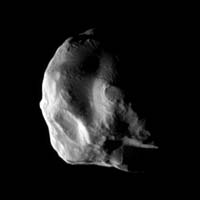 Closest View of Helene
The Cassini spacecraft snapped this image during the spacecraft's closest flyby of Saturn's moon Helene, on March 3, 2010.
See PIA09015 for the previous closest view of Helene (33 kilometers, or 21 miles across). The small moon leads the much larger Dione by 60 degrees in the moons' shared orbit. Helene is a "Trojan" moon of Dione, named for the Trojan asteroids that orbit 60 degrees ahead of and behind Jupiter as the giant planet circles the Sun.
Lit terrain seen here is on the anti-Saturn side of Helene. The south pole of the moon is in the lower right of the image.
The image was taken in visible light with the Cassini spacecraft wide-angle camera. The view was obtained at a distance of approximately 1,900 kilometers (1,200 miles) from Helene and at a Sun-Helene-spacecraft, or phase, angle of 90 degrees. Scale in the original image was 235 meters (771 feet) per pixel. The image has been magnified by a factor of two and contrast-enhanced to aid visibility.
(Courtesy NASA/JPL/Space Science Institute)
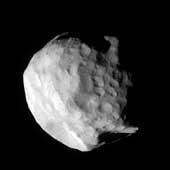 Helene of Troy
The Cassini spacecraft reveals details on the surface of small,
irregularly shaped Helene in this close-up view, obtained during the
spacecraft's closest encounter with this moon during its four-year primary
mission.
Helene (32 kilometers, or 20 miles across) is a Trojan moon, sharing Dione's orbit but staying 60 degrees or 400,000 kilometers (250,000 miles) ahead of the much larger moon.
The image was taken in visible green light with the Cassini spacecraft
narrow-angle camera on July 20, 2007. The view was acquired at a distance
of approximately 39,000 kilometers (24,000 miles) from Helene and at a
Sun-Helene-spacecraft, or phase, angle of 61 degrees. Image scale is 231
meters (758 feet) per pixel.
(Courtesy NASA/JPL/Space Science Institute)
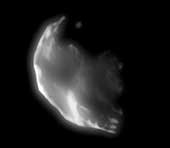 Helene
Cassini came close to Saturn's small moon Helene on Feb. 25, 2006,
acquiring this high-resolution view. This object seems to be buried in its
own crater debris, like another Saturnian moon, Telesto.
Helene (32 kilometers, or 20 miles across) orbits 60 degrees ahead of Dione in the larger moon's orbit, making it a "trojan" moon of Dione. Trojan moons are named for the Trojan group of asteroids that orbit 60 degrees ahead of and behind Jupiter as it circles the sun.
This image was taken in visible light with the Cassini spacecraft
narrow-angle camera at a distance of approximately 68,000 kilometers
(42,000 miles) from Helene and at a sun-Helene-spacecraft, or phase, angle
of 99 degrees. Image scale is 406 meters (1,334 feet) per pixel.
(Courtesy NASA/JPL/Space Science Institute)
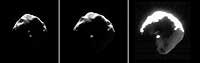 Helene's Close-up
This set of images exposes details on small and crumpled-looking Helene.
Large portions of this Trojan moon of Dione appear to have been blasted
away by impacts.
Cassini passed within 50,000 kilometers (31,000 miles) of Helene (32 kilometers, or 20 miles across) on Aug. 17, 2006, when these images were acquired. The views were obtained over the course of an hour, and are presented here in reverse order (i.e., the leftmost image was taken latest).
The images were taken in visible light with the Cassini spacecraft
narrow-angle camera. As presented here, the views were acquired at
distances ranging from 62,000 to 51,000 kilometers (39,000 to 32,000
miles) from Helene and at a Sun-Helene-spacecraft, or phase, angle of 111
to 120 degrees. Image scale is 375 to 300 meters (1,230 to 984 feet) per
pixel, from left to right.
(Courtesy NASA/JPL/Space Science Institute)
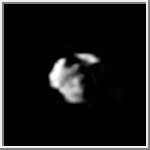 Helene
This image of Helene was acquired by the Voyager 2 spacecraft on
August 25, 1981.
(Copyright Calvin J. Hamilton)

 Saturn
 Dione
Dione Rhea
Rhea