|
COMETS EARTH JUPITER KUIPER BELT MARS MERCURY METEORITES NEPTUNE OORT CLOUD PLUTO SATURN SOLAR SYSTEM SPACE SUN URANUS VENUS ORDER PRINTS
PHOTO CATEGORIES SCIENCEVIEWS AMERICAN INDIAN AMPHIBIANS BIRDS BUGS FINE ART FOSSILS THE ISLANDS HISTORICAL PHOTOS MAMMALS OTHER PARKS PLANTS RELIGIOUS REPTILES SCIENCEVIEWS PRINTS
|
 |
Related Document
Download Options
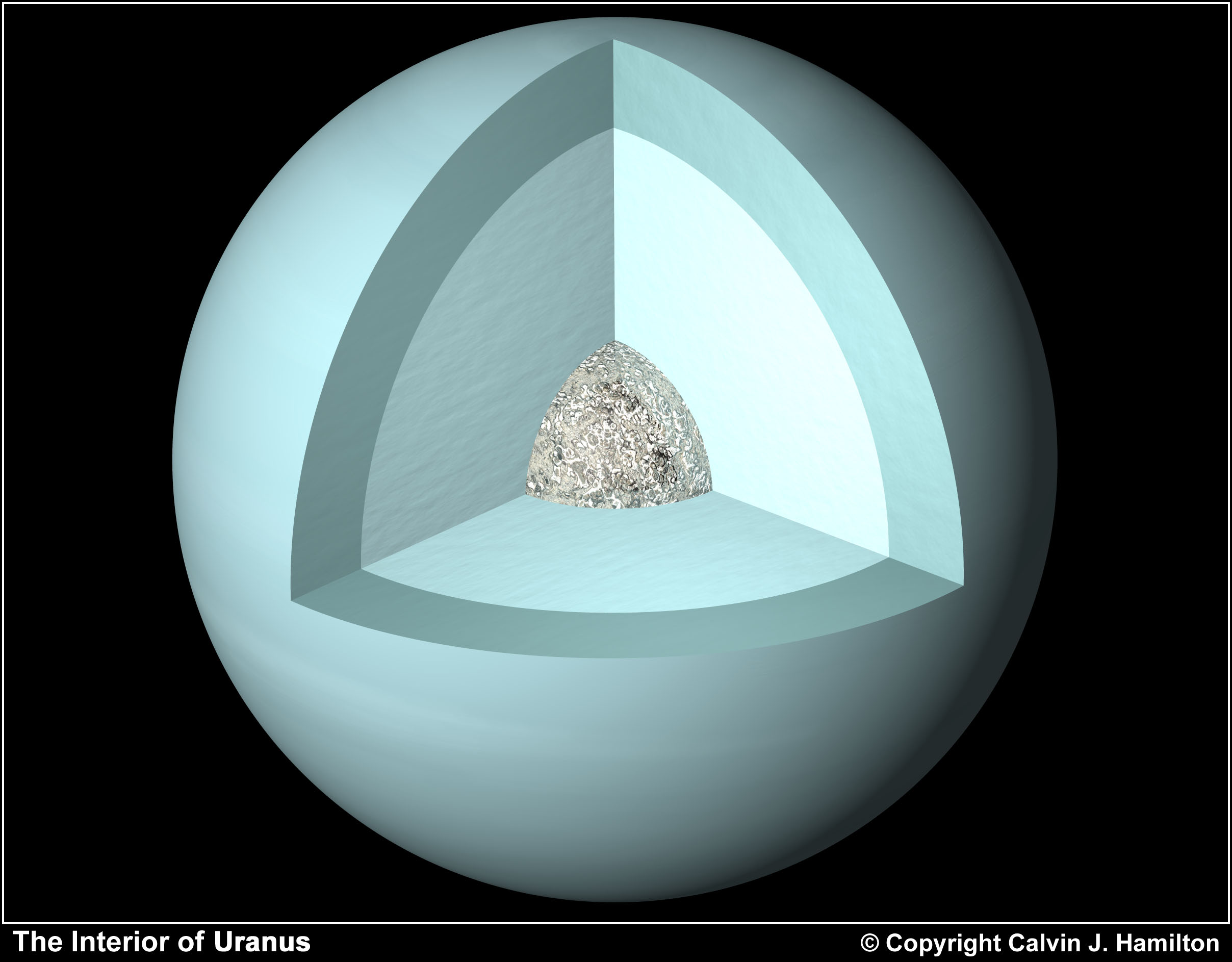
Our knowledge of the internal structure of Uranus is inferred from the planet's radius, mass, period of rotation, the shape of its gravitational field and the behavior of hydrogen, helium, and water at high pressure. Its internal structure is similar to that of Neptune except for the fact that it is less active in terms of atmospheric dynamics and interior heat flow. This cut-away view shows Uranus composed of an outer envelope of molecular hydrogen, helium and methane roughly the mass of one to two Earths. Below this region Uranus appears to be composed of a mantle rich in water, methane, ammonia, and other elements. These elements are under high temperatures and pressures deep within the planet. The mantle is equivalent to 10 to 15 earth masses. Uranus's core is composed of rock and ice, and is likely no more than one Earth mass. This image is © Copyright © 2001 by Calvin J. Hamilton. Any commercial/for-profit use of the image needs to be addressed to the Author. |
|||||||||||||||||||||||||||||||||